A 21st-century icon, built in sevens and thousands.
The London Eye is the world's tallest cantilevered observation wheel — and one of the most loved landmarks on the Thames. Here are the figures, records and engineering feats behind it.
Equivalent to 64 red telephone boxes stacked.
One per London borough. Numbered to 33 — pod 13 omitted for luck.
As far as Windsor Castle on a clear day.
A stately 26cm per second — twice as fast as a sprinting tortoise.
Equivalent to 11 London red double-decker buses.
Each of the 32 pods weighs the same as 1,157,894 pound coins.
The total distance around the wheel — 1,392 feet.
7,668 rotations — equivalent to London to Cairo.
Since opening, more than 5,000 marriage proposals on board.
New LED lighting saves 75% more energy than the previous system.
Used in construction — 298× the weight of London's top football teams combined.
Originally a temporary structure with 5-year planning permission.
London's 21st-century Eiffel Tower.
Architects and husband-and-wife team David Marks and Julia Barfield wanted to mark the new millennium with something enduring — a structure of beauty that would celebrate London's creativity and give it a new perspective on itself.
They chose a wheel: an age-old symbol of time and change, and the perfect shape for a city that never stands still. It was so simple, so visionary, it's surprising no one had thought of it years before.
Originally granted just five years of planning permission, the London Eye was meant to be temporary. With millions boarding it every year, it became permanent — and the UK's most popular paid visitor attraction.
A bicycle wheel, scaled 200×.
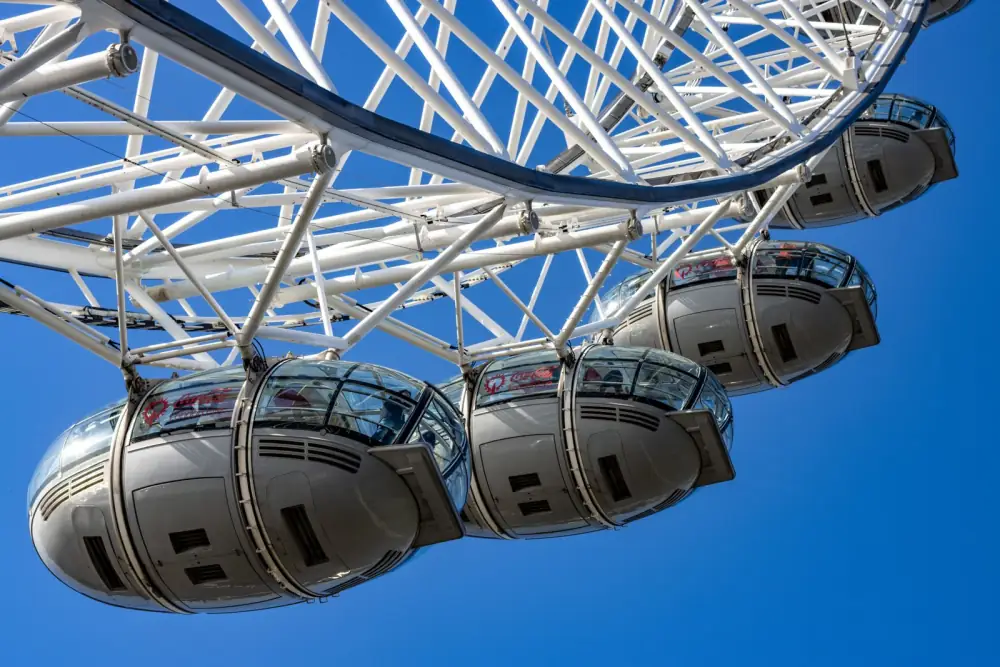
It's often mistaken for a Ferris wheel. It isn't. The pods are fully enclosed, motorised, and mounted on the outside of the rim — and the entire structure is supported on one side by an A-frame, making it the world's tallest cantilevered observation wheel.
- 01
Designed by architects David Marks & Julia Barfield as London's 21st-century Eiffel Tower — a symbol of creativity, innovation and technical prowess.
- 02
It took seven years and hundreds of people from five countries to make the London Eye a reality.
- 03
Designed as a giant bicycle wheel — over 200× larger than the average bike wheel, and four times wider than the dome of St Paul's Cathedral.
- 04
The 80 cable spokes, laid end to end, would stretch 6km — from Trafalgar Square to Canary Wharf.
- 05
The 23-metre spindle holds a hub weighing 330 tonnes — 49 double-decker buses, or 20× the weight of Big Ben.
- 06
The wheel was shipped up the Thames in sections by barge. Clearance under Southwark Bridge was just 40cm in places.
- 07
It took a week to lift the entire structure from horizontal to vertical — using technology previously developed for North Sea oil rigs.
- 08
All 32 pods were fixed onto the wheel in just eight days. Upgraded a decade later for greener heating and ventilation, they're built to last another 10+ years.
- 09
All oils used on the wheel are biodegradable, the grease is edible, and cleaning products are non-pollutant.
Hollywood, Royals & rotations.
Supermodel Kate Moss holds the UK record for most rotations.
Hollywood star Jessica Alba holds the international record.
Focal point of the Mayor of London's New Year's Eve fireworks for over 15 years running.
The Eye has appeared in Fantastic Four: Rise of the Silver Surfer, Harry Potter and the Deathly Hallows, Paddington, Thunderbirds, Doctor Who, Sherlock and The Simpsons. It played an integral role in the London 2012 Olympic & Paralympic Games — the Olympic Torch sat atop one of its pods and the Eye featured in both ceremonies.
Common questions.
How many stories is the London Eye?
The London Eye stands 135 metres (443 feet) tall — roughly the same height as a 45-storey building. On a clear day you can see up to 40 kilometres away, as far as Windsor Castle.
How much does the London Eye weigh?
The whole structure weighs around 2,100 tonnes. That includes 1,700 tonnes of British steel in the wheel itself — about 298 times the combined weight of London's top football teams. The 23-metre spindle alone holds a hub weighing 330 tonnes.
See it for yourself.
The numbers are impressive, but they're nothing next to the view from 135 metres.